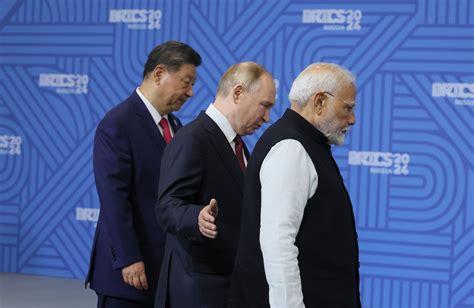
BRICS Summit Shows Putin Isn’t Alone\n\nAlright guys, let’s dive into something super interesting and often misunderstood in today’s global landscape: the BRICS summit. For a while now, Western media and political narratives have often painted a picture of Russian President Vladimir Putin as an
isolated figure
on the world stage, cut off from meaningful international partnerships, especially after the events in Ukraine. But if we’re being honest and looking at the bigger picture, particularly through the lens of recent BRICS gatherings, that narrative really starts to crumble, doesn’t it? The
BRICS summit
isn’t just another talking shop; it’s a powerful statement from a significant chunk of the world’s population and economy, actively reshaping the global order. It demonstrates, quite unequivocally, that
Putin isn’t alone
in his vision for a multipolar world and that Russia maintains robust, strategic alliances with key players in the Global South. These summits serve as critical platforms for economic cooperation, political dialogue, and cultural exchange among Brazil, Russia, India, China, and South Africa, and increasingly, with other nations eager to join this influential bloc. The sheer scale of these economies and their collective geopolitical weight mean that any unified stance or significant partnership formed within this group sends ripples across international relations. It’s a compelling counter-narrative to the idea of a universally ostracized Russia, showing instead a nation deeply embedded within an alternative global framework that’s gaining momentum and challenging established hegemonies. So, when we talk about
Putin’s global standing
, it’s crucial to acknowledge the strength and resilience of these non-Western alliances.\n\n## The Geopolitical Chessboard: BRICS as a Counterbalance\n\nLet’s be real, folks, the world isn’t a simple game of checkers; it’s a highly complex, multi-layered game of
geopolitical chess
, and BRICS has firmly planted itself as a major queen on that board, acting as a significant counterbalance to traditional Western dominance. Originally conceived as an acronym for rapidly developing economies by an economist, BRICS has evolved into a formidable intergovernmental organization comprising Brazil, Russia, India, China, and South Africa. These nations collectively represent over 40% of the world’s population and roughly a quarter of the global GDP, making them an economic powerhouse that simply cannot be ignored. Their raison d’être extends beyond mere economic cooperation; it’s about pushing for a
more equitable, multipolar world order
where the voices and interests of the Global South are heard and respected, rather than being dictated by a few historically powerful nations. They aim to reform global governance institutions like the UN, IMF, and World Bank, which they perceive as being skewed towards Western interests, advocating for a system that better reflects today’s geopolitical realities. This collective ambition for greater sovereignty, economic independence, and a diversified global financial system is a core tenet that binds these diverse nations together, creating a powerful front that actively challenges the unipolar world vision. It’s about creating alternatives, forging new pathways for development, and ensuring that no single power or bloc can unilaterally dictate the terms of international engagement. This aspiration for a balanced global stage, where power is distributed more broadly, is a critical factor in understanding the enduring strength and appeal of the BRICS grouping.\n\n### Economic Might and Shifting Power Dynamics\n\nNow, let’s talk brass tacks about what truly underpins the BRICS bloc’s growing influence: its
economic might
and the palpable shift in global power dynamics it represents. We’re not just talking about abstract numbers here, guys; we’re talking about real economies, real people, and real trade flows that are fundamentally altering how the world operates. The BRICS nations have been incredibly proactive in building alternative financial architectures, most notably through the New Development Bank (NDB), sometimes referred to as the ‘BRICS Bank.’ This institution was created precisely to provide an alternative to Western-dominated financial bodies, offering infrastructure and sustainable development projects primarily within BRICS countries and other developing nations, thereby reducing their reliance on institutions like the IMF and World Bank, which often come with strict conditions. Beyond the NDB, there’s a significant push towards
de-dollarization
, with members increasingly conducting trade in local currencies or through bilateral currency swap agreements. This isn’t just a political statement; it’s a strategic move to insulate their economies from the volatility of the U.S. dollar and the potential for financial sanctions. India and Russia, for example, have explored using the rupee and ruble for trade, while China is actively promoting the yuan as an international reserve currency. These efforts collectively aim to foster greater financial sovereignty and resilience within the bloc, illustrating a determined move away from a global financial system largely centered around the dollar. This economic realignment is perhaps the most tangible expression of the BRICS vision for a multipolar world, where economic power is diversified and nations have more agency over their financial destinies, truly showcasing a dramatic shift in global economic gravity. It’s an exciting, albeit complex, landscape to navigate, and BRICS is right at the heart of it.\n\n## Putin’s Presence: Defying Western Narratives\n\nSo, let’s cut to the chase about
Putin’s presence
at these BRICS summits, because it’s arguably one of the most powerful repudiations of the widespread Western narrative that he’s an international pariah. Despite immense pressure, sanctions, and diplomatic efforts from Western powers to isolate Russia, Putin’s engagement, whether physical or virtual, at these high-level BRICS gatherings speaks volumes. It’s not just about showing up; it’s about being received by fellow leaders as an equal, participating in substantive discussions, and jointly shaping critical international policies alongside some of the world’s most populous and economically dynamic nations. This level of participation directly contradicts the image of an internationally ostracized leader, instead showcasing a network of strategic alliances that remain robust and committed, even in the face of global scrutiny. The BRICS leaders, through their continued engagement with Russia, have implicitly and explicitly expressed a desire for a global order that respects national sovereignty and resists unilateral pressure. They haven’t bowed to Western demands to sever ties with Moscow; instead, they’ve prioritized their own national interests and a shared vision for a more balanced international system. This
unity
among BRICS members, despite their individual geopolitical nuances, is a powerful message in itself, signaling that a significant portion of the world is not willing to play by rules dictated solely by the West. It highlights how these nations are navigating a complex geopolitical landscape by prioritizing mutually beneficial cooperation over succumbing to external pressures, thus creating a legitimate and powerful counter-narrative to the prevailing Western view of Russia’s global standing. It’s a bold statement that Russia retains significant, powerful allies who are committed to a future where diverse voices hold sway.\n\n### Strategic Alliances and Shared Interests\n\nBeyond the headlines, it’s crucial to understand that the enduring strength of BRICS, and indeed Russia’s place within it, stems from a deep wellspring of
strategic alliances and shared interests
. This isn’t just about a superficial handshake for the cameras, guys; it’s about fundamental common ground that truly binds these diverse nations together. At its core, BRICS members share a collective desire for a
more equitable global system
, one where decision-making power is diffused, and multilateralism is truly embraced, rather than being a polite facade for unilateral action. They are united by a common skepticism towards institutions and norms largely shaped by post-WWII Western hegemony, seeking instead a platform where their economic development and political sovereignty are paramount. This includes advocating for greater representation in international bodies, pushing back against what they perceive as interventionist foreign policies, and building robust south-south cooperation models. Think about it: Russia provides critical energy resources and military technology; China offers vast economic investment and manufacturing capabilities; India brings a massive market and technological prowess; Brazil contributes agricultural power; and South Africa serves as a gateway to the African continent. These complementary strengths create a powerful synergy that benefits all members, fostering robust trade relationships, joint development projects, and collaborative initiatives that enhance their collective security and prosperity. It’s a pragmatic partnership built on mutual benefit and a shared vision of a world where diverse nations can thrive without external coercion, firmly establishing the legitimacy and necessity of these alliances in the current global climate.\n\n## Expanding Influence: The BRICS Expansion\n\nNow, let’s talk about one of the most exciting and indicative developments within the BRICS narrative: its
expanding influence
through the significant
BRICS expansion
. This isn’t just about the original five members anymore, guys; we’re witnessing the birth of a
BRICS+
phenomenon, a clear signal that the bloc’s appeal and model are resonating deeply across the Global South. The recent additions of countries like Saudi Arabia, Iran, UAE, Egypt, Ethiopia, and Argentina (though Argentina’s new government has since opted out for now, the initial invitation still speaks volumes about the demand) are monumental. These nations collectively represent massive populations, significant economic clout, and strategic geopolitical positions, further bolstering BRICS’s global reach and power. So, why are so many countries knocking on BRICS’s door, eager to join the club? It boils down to a few key factors: a desire for greater economic independence, a platform to voice their national interests without being overshadowed by traditional powers, and access to new trade routes and investment opportunities. Many see BRICS as a viable alternative to the Western-dominated order, offering a path to development and influence that respects their sovereignty and diverse political systems. This expansion fundamentally shifts the geopolitical balance, creating a larger, more diverse bloc that can exert even greater influence on issues ranging from trade and finance to climate change and international security. It’s a clear indicator that the vision of a multipolar world isn’t just a theoretical concept; it’s actively taking shape, with BRICS at its vanguard, drawing in nations that are keen to carve out their own destinies on the global stage, away from the perceived strictures of older alliances. This growth makes BRICS an undeniable force, reshaping international relations in ways we’re only just beginning to fully comprehend.\n\n### What the Future Holds for Global Governance\n\nWith the undeniable momentum of BRICS and its expanding membership, it’s absolutely crucial to ponder
what the future holds for global governance
. We’re not just talking about minor tweaks to the system here, folks; we’re talking about a fundamental reshaping of how international affairs are conducted. A stronger, expanded BRICS bloc will undoubtedly wield significant influence across a spectrum of global issues, challenging the very foundations of institutions that have largely operated under Western paradigms for decades. Expect to see intensified calls for reform within the United Nations, particularly the Security Council, advocating for greater representation from developing nations. The economic impact will be profound, too; the push for de-dollarization will likely accelerate, leading to a more diversified international monetary system where multiple currencies play a significant role. This could mitigate the power of any single nation to use its currency as a tool of foreign policy, fostering greater financial stability for many countries. Moreover, the BRICS’s focus on South-South cooperation, infrastructure development, and climate action will offer alternative models and solutions to global challenges, reflecting the diverse perspectives and priorities of the Global South. This emerging multipolar reality means a more complex, nuanced, and potentially more equitable global system, but also one with increased competition and potentially new geopolitical fault lines. It implies a world where consensus-building will require broader engagement and where no single power can unilaterally dictate global norms or policies. It’s a thrilling, yet challenging, prospect, and understanding this shift is key to navigating the international landscape of tomorrow. The world is evolving, and BRICS is a major architect of that evolution, promising a future of distributed power and diverse voices.\n\n## Conclusion: A New Global Order Emerges\n\nSo, there you have it, guys. When we zoom out and look at the whole picture, especially through the lens of recent BRICS summits, the narrative of
Putin’s isolation
simply doesn’t hold up. These gatherings have consistently demonstrated that Russia, under Vladimir Putin, remains a deeply integrated and influential player within a significant and growing bloc of nations that are actively working to reshape the global order. The BRICS alliance—comprising Brazil, Russia, India, China, and South Africa, and now expanding to include other key players—isn’t just a loose collection of countries; it’s a formidable force advocating for a
multipolar world
, one where power is distributed more equitably, and the voices of the Global South are heard loud and clear. From challenging Western-dominated financial institutions with initiatives like the New Development Bank and pushing for de-dollarization, to fostering deep strategic alliances based on shared interests and mutual respect, BRICS is clearly laying the groundwork for a future where no single superpower dictates international terms. The continued engagement of Putin with these leaders, the robust economic ties, and the strategic alignment on critical global issues all underscore a profound truth: Russia is not alone. Instead, it is a key architect in the emergence of a new global order, one that values sovereignty, economic independence, and a diversified approach to international relations. This shift is irreversible, indicating that the world is moving beyond a unipolar framework towards a more complex, balanced, and potentially more representative international system. Understanding the power and trajectory of BRICS is crucial for anyone hoping to make sense of the evolving geopolitical landscape, as it undeniably heralds a future where power is shared, and many voices contribute to the global dialogue. It’s an exciting time to be observing these seismic shifts in international power dynamics!\n
