Crafting a Newscast Script: Your Guide to TV News\n\nHey there, future broadcast journalists and content creators! Ever wondered what it takes to put together a compelling news show? It all boils down to one crucial document: the
newscast script
. This isn’t just a simple rundown; it’s the very heartbeat of your broadcast, a detailed blueprint that guides anchors, reporters, and producers through every single second of airtime. A well-crafted
newscast script
ensures clarity, coherence, and professional delivery, making sure your audience stays informed and engaged. Trust us, guys, mastering the art of
newscast scriptwriting
is an invaluable skill, whether you’re aiming for the big leagues of national news or producing content for your local community or even your own online channel. It’s about translating complex information into easy-to-understand segments that flow seamlessly from one story to the next. In this comprehensive guide, we’re going to dive deep into every aspect of
crafting a truly impactful newscast script
, from the initial research to the final polished draft. Get ready to unlock the secrets of broadcast storytelling and make your news shine!\n\n## Understanding the Core Elements of a Newscast Script\n\nSo, what exactly makes up a
newscast script
, folks? At its heart, a
newscast script
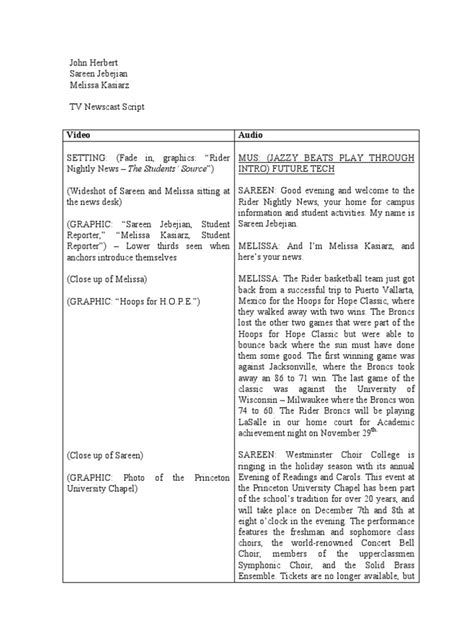
is a meticulously detailed document that outlines every spoken word, every visual cue, and every sound bite for a broadcast news program. It’s the ultimate guide for everyone involved, from the on-air talent to the control room crew. Think of it as the nervous system of your show, ensuring everything works in perfect synchronicity. In the fast-paced world of
broadcast journalism
, clarity and conciseness aren’t just good practices; they’re absolute necessities. Your script needs to be written for the ear, meaning it should sound natural and conversational when spoken aloud, unlike written prose that’s meant to be read silently. This involves using shorter sentences, simpler language, and avoiding jargon wherever possible. The audience is listening and watching, not reading along, so the information needs to be instantly digestible.\n\nKey components of any robust
newscast script
include:
Voice Overs (VOs)
, which are short bits of video footage played while the anchor reads accompanying narration;
Sound on Tape (SOTs)
, direct audio and video clips of interviews or natural sound (like crowd noise or a snippet of a speech);
VO/SOTs
, a combination where an anchor reads over video before a pre-recorded sound bite plays;
Reporter Packages
, which are pre-produced, edited stories filed by a reporter from the field, often including VOs, SOTs, and a stand-up; and finally,
Anchor Intros and Outros
, the segments where the anchors introduce or conclude stories, provide transitions, and sign off the broadcast. Each of these elements needs specific instructions within your
news writing
to guide production. For instance, a VO needs to clearly state what video should be playing, and an SOT needs to specify its duration and who is speaking. Moreover, every script must account for graphics – lower thirds identifying speakers or locations, full-screen graphics displaying statistics or maps – as these are crucial visual aids for the audience. The goal is to paint a complete picture for the viewer, using both auditory and visual elements in tandem.
Accuracy
is paramount; every fact, name, and statistic must be double-checked. A single factual error can undermine the credibility of your entire broadcast. Therefore, guys, crafting these individual segments with precision, ensuring they flow logically and maintain a consistent tone, is the foundational step in creating an effective
newscast script
. It’s about being thorough, clear, and always keeping the viewer’s understanding at the forefront of your
news writing
process.\n\n## Pre-Scripting Essentials: Research and Story Selection\n\nBefore you even think about putting pen to paper (or fingers to keyboard!) to write your
newscast script
, you need to have a rock-solid foundation of
news research
and smart
story selection
. This is where the real journalistic heavy lifting happens, folks. You can’t write about what you don’t know, right? So, the very first step is to identify compelling and relevant topics that resonate with your target audience. What’s happening in your community, nationally, or internationally that people
need
to know about? What’s affecting their lives, sparking discussions, or offering a fresh perspective? This isn’t just about finding any story; it’s about applying sound
news judgment
to determine what is truly newsworthy. Consider factors like impact, timeliness, proximity, prominence, and human interest. A story about a local school board decision might have more immediate impact on your viewers than a faraway international conflict, depending on your broadcast’s focus.\n\nOnce you’ve identified potential stories, the deep dive into
news research
begins. This involves gathering facts, statistics, quotes, and background information from multiple, credible sources. Remember, in
journalism ethics
, verifying information is non-negotiable. Don’t rely on a single source, especially for contentious or sensitive topics. Interview primary sources, consult official documents, review reputable news archives, and always cross-reference your data. In today’s digital age, with a constant deluge of information and misinformation, the ability to discern reliable sources from unreliable ones is more critical than ever. We’re talking about rigorous fact-checking, guys, because the credibility of your entire newscast rests on the accuracy of each individual story. What are the opposing viewpoints? Have you considered all sides of the issue? Are there any potential biases you need to be aware of and address?\n\nUnderstanding your audience is another crucial piece of this pre-scripting puzzle. Who are you trying to reach? What are their interests, concerns, and demographic profiles? Tailoring your
story selection
and the angle of your reporting to your audience ensures that your news is not only informative but also genuinely engaging and relevant to them. A morning news program for commuters might focus on traffic and weather alongside top headlines, while an evening newscast might delve deeper into investigative pieces or feature stories. Finally, consider the visual elements of your chosen stories. Can they be effectively told with video, graphics, and compelling sound? A story might be incredibly important, but if it lacks strong visual potential, it can be challenging to translate into an engaging broadcast segment. By meticulously conducting your
news research
and making astute
story selection
decisions, you’re setting your
newscast script
up for success even before you write the first word, ensuring your content is not just accurate but also impactful and resonant with your viewers. This groundwork is the secret sauce, folks, to truly great
broadcast journalism
.\n\n## Structuring Your Newscast Script: The Blueprint for Broadcast\n\nAlright, guys, you’ve got your compelling stories and all your facts are lined up. Now comes the exciting part: giving your show a coherent flow by meticulously
structuring your newscast script
. This isn’t just about putting stories in any random order; it’s about crafting a narrative arc for your entire broadcast that keeps your audience hooked from start to finish. A well-organized
newscast structure
is the invisible hand that guides viewers through your program, making sure the pacing feels just right and transitions are seamless, never jarring. Typically, a newscast is divided into several timed blocks, often labeled A, B, C, and so on, separated by commercial breaks. Each block serves a specific purpose, contributing to the overall rhythm and information delivery of the show.\n\nThe show usually kicks off with a
cold open
, a brief, attention-grabbing visual or sound bite that teases a major story before the main intro. This immediately draws viewers in. Following this, the
A block
is usually the heaviest news section, featuring the top, most impactful headlines of the day. This is where your lead story, often the most significant or urgent piece, will reside. It’s crucial to hit hard and fast with the most important information here to capture attention. After the A block, you’ll have a commercial break, often preceded by a
teaser
– a short, intriguing preview of stories coming up in later blocks. These teasers are vital for viewer retention, giving them a reason to stick around through the commercials.\n\nSubsequent blocks, like the
B block
and
C block
, will typically contain a mix of secondary news stories, feature pieces, lighter news, and sometimes longer reporter packages. The content often transitions from the hardest news to more human interest or lifestyle stories as the show progresses. The
newscast structure
also involves careful consideration of the
flow and pacing
. You don’t want too many heavy or similar stories back-to-back, as this can overwhelm or bore the audience. A good mix of serious news, lighter segments, and varying story lengths creates a dynamic and engaging pace.
Segment transitions
are another critical element. How do you move from one story to the next, or from an anchor reading to a reporter package, without awkward pauses or abrupt changes? This is where your
broadcast script format
comes into play, with clear cues for anchors (
