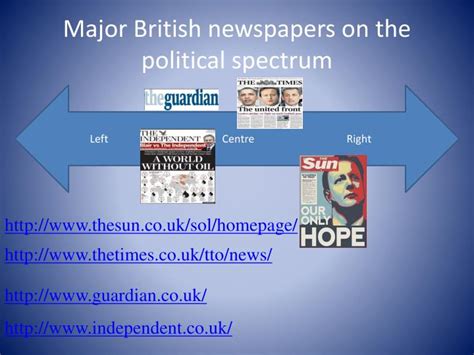
UK Newspapers: Navigating the Political Spectrum\n\nAlright, guys, let’s dive into something super fascinating and
critically important
if you want to understand the British media landscape: the
UK newspapers’ political spectrum
. It’s not just about what stories they cover, but
how
they cover them, and what underlying values or political leanings often shine through. Understanding this isn’t just for political junkies; it’s essential for anyone who wants to be a well-informed citizen and avoid getting caught in an echo chamber. We’re talking about a rich, diverse, and sometimes
fiercely partisan
world of news that shapes public opinion, influences elections, and often reflects the very soul of the nation. From the broadsheets to the tabloids, each publication has its own unique flavour, its own set of loyal readers, and its own place on the political compass, from the staunch left to the robust right, with a few brave souls trying to navigate the tricky middle ground. This isn’t just about reading headlines; it’s about
deciphering narratives
and understanding the subtle (and sometimes not-so-subtle) biases that underpin daily news consumption. So, buckle up, because we’re going on a grand tour of Britain’s press, exploring the
political leanings
of its most prominent newspapers and helping you become a much savvier news consumer.\n\n## Understanding the UK’s Diverse Media Landscape\n\nWhen we talk about the
UK’s diverse media landscape
, we’re truly looking at a vibrant, often boisterous, and deeply ingrained part of British culture. Unlike some other nations where media might be more centralized or homogenous, the UK boasts a rich tapestry of newspapers, each with its own history, editorial stance, and target demographic. This isn’t just some academic exercise, folks; knowing where a newspaper sits on the
political spectrum
is
crucial
because it directly impacts the stories you read, the angles presented, and ultimately, how you perceive national and global events. Imagine tuning into a radio station – you wouldn’t expect classical music from a rock station, right? It’s the same with newspapers. A
Daily Mail
reader is often looking for a very different take on current affairs than a
Guardian
reader, and understanding this fundamental difference is the first step towards
media literacy
. This incredible diversity didn’t happen overnight; it’s a product of centuries of journalistic tradition, fierce competition, and a societal appetite for news that caters to various viewpoints and social classes. From the powerful broadsheets that delve deep into policy and economics to the punchy tabloids that focus on human interest and celebrity gossip (often with a strong political undercurrent), every paper plays a role in the national conversation. \n\nHistorically, many of these papers were established with a clear political agenda, often directly affiliated with political parties or movements. While direct party ownership is less common today, the legacy of these ideological roots remains strong, influencing editorial lines, columnist choices, and even the language used to describe political figures or policies. For instance, the language used to describe immigration or economic policy will vastly differ between a left-leaning paper and a right-leaning one, even when reporting on the exact same event. This isn’t necessarily about outright falsehoods – though that can happen – but more about
emphasis
,
framing
, and the
selection
of facts and opinions. Furthermore, the advent of digital media has only added more layers to this complexity. While some traditional papers have successfully transitioned online, new digital-only platforms have also emerged, further fragmenting the audience and, in some cases, amplifying specific ideological niches. Navigating this landscape means understanding that no single newspaper offers the complete, unbiased truth. Instead, each provides a valuable piece of the puzzle, filtered through its particular lens. So, when you pick up a paper or click on an article online, it’s not just about consuming information; it’s about actively engaging with a specific perspective, and being aware of that perspective is what makes you a smarter, more discerning news consumer. It’s about empowering yourselves to form your
own
opinions, rather than passively accepting a predetermined narrative. This fundamental grasp of the media ecosystem is invaluable, truly, for anyone looking to make sense of the complex world around us.\n\n## The Left-Leaning Press: A Closer Look\n\nWhen we talk about the
left-leaning press
in the UK, we’re talking about publications that generally champion social justice, advocate for stronger public services, support wealth redistribution, and often scrutinize corporate power. These papers tend to appeal to readers who identify with socialist, liberal, or social democratic values, emphasizing community, equality, and often a more internationalist perspective. They’re the ones you’ll see highlighting issues like climate change with urgency, defending workers’ rights, and often taking a more critical stance on austerity measures or privatization. For many, these publications are a vital voice, offering an alternative narrative to what they might perceive as a more conservative mainstream. They often feature columnists who are outspoken critics of government policy, particularly when a Conservative government is in power, and they provide platforms for progressive thinkers and activists. The tone can be passionate and analytical, aiming to provoke thought and encourage social change. Historically, the British left-wing press has played a crucial role in shaping public discourse, particularly concerning major social reforms, trade union movements, and civil liberties. They’ve often been at the forefront of investigative journalism, uncovering scandals and holding powerful institutions to account. So, if you’re keen on understanding the counter-arguments to establishment views or exploring stories through a lens that prioritizes societal welfare and collective responsibility, these are the papers you’ll want to have on your radar. They provide a crucial balance in the overall media ecosystem, ensuring that a broad range of progressive viewpoints are represented and debated, even if sometimes they can be seen as overly critical or idealistic by those on the other side of the political divide. It’s all about perspective, guys, and these papers offer a distinct one.\n\n###
The Guardian
: Championing Liberal Values\n\nFirst up in our tour of the left-leaning media, we absolutely
have
to talk about
The Guardian
. This newspaper is, without a doubt, a titan of the
UK’s liberal press
, known globally for its in-depth, investigative journalism and its unwavering commitment to progressive values. If you’re looking for a publication that champions human rights, environmentalism, social justice, and international cooperation,
The Guardian
is pretty much your go-to. It often takes a critical stance on government policy, particularly when it perceives policies to infringe on civil liberties or exacerbate social inequalities. Its editorial line consistently reflects a strong belief in public services, advocating for robust healthcare, education, and welfare systems, often pushing back against privatization efforts. The paper’s coverage of climate change, for instance, is consistently urgent and comprehensive, reflecting its deep concern for environmental sustainability. When it comes to economic policy,
The Guardian
typically leans towards redistribution of wealth, advocating for stronger regulation of corporations and higher taxes on the wealthy to fund public spending. \n\nWhat truly sets
The Guardian
apart, guys, is its rigorous approach to reporting and its dedication to factual accuracy, even as it clearly articulates a left-of-centre viewpoint. It’s known for its extensive network of foreign correspondents, providing nuanced and often critical perspectives on global affairs, from conflicts to international development. The paper’s digital presence is particularly strong, with its website being one of the most widely read English-language news sites globally, supported by a unique ownership structure – the Scott Trust – which ensures its editorial independence from commercial or political interference. This means its primary goal isn’t profit, but upholding its journalistic mission. While it doesn’t shy away from being opinionated, especially in its comment sections, it also provides a wealth of factual reporting. Its readership tends to be educated professionals, often in London and the South East, and those who align with the Labour Party or Liberal Democrats. The paper offers extensive analysis on complex issues, often delving into the historical context and potential future implications of political decisions. So, if you’re after serious journalism that challenges the status quo, explores global issues in depth, and advocates for a more equitable and sustainable world,
The Guardian
should definitely be on your daily reading list. It’s not just a newspaper; for many, it’s a standard-bearer for progressive thought and
truly indispensable
for understanding the left’s perspective in the UK. Its influence extends far beyond its physical circulation, shaping debates and setting agendas for other media outlets and political discourse at large. Seriously, it’s a powerhouse of liberal thought and a crucial voice in the national conversation.\n\n###
The Mirror
: Voice of the Working Class\n\nNext up, let’s turn our attention to
The Mirror
, a truly iconic presence in the
UK’s working-class press
. Often simply referred to as
The Mirror
(or sometimes the
Daily Mirror
), this tabloid newspaper has a long and proud history of championing the rights and concerns of ordinary working people. Its editorial stance is staunchly
Labour-leaning
, often serving as a passionate advocate for the Labour Party and its policies. If you want to understand the heartbeat of a significant segment of the British electorate, particularly those in traditional Labour heartlands,
The Mirror
provides an invaluable window. It’s not just reporting the news; it’s often
campaigning
on behalf of its readers, taking on issues like social inequality, the cost of living crisis, and the state of the NHS with a fierce, unwavering determination. The paper’s tone is typically direct, empathetic, and often emotive, designed to resonate deeply with its readership. It uses a more accessible language than the broadsheets, making complex political issues understandable to a wider audience, often through compelling human-interest stories that put a face to policy decisions.\n\n
The Mirror
has consistently stood up for the less privileged, criticizing policies that it believes harm the working class, such as cuts to welfare benefits or the impact of austerity. It often publishes investigative pieces that highlight corporate greed or governmental failings that affect ordinary families. Historically, it has been a vocal opponent of Conservative governments, using its front pages to galvanize public opinion and rally support for Labour. Its readership primarily comprises working-class individuals and those with strong trade union ties, particularly in the North of England and Scotland, though its influence extends nationwide. While it may sometimes be criticized for its sensationalist headlines or its strong partisan leanings, there’s no denying its role as a powerful voice for the left. Guys, it’s important to remember that
The Mirror
’s strength lies in its ability to connect with its audience on an emotional level, providing news and commentary that directly speaks to their lived experiences and aspirations. It’s a paper that truly feels like it’s
on your side
if you’re a working-class individual grappling with daily challenges. Its coverage often focuses on stories that might be overlooked by more establishment-leaning papers, bringing crucial issues of social justice and economic fairness to the forefront. So, for a perspective that is unequivocally rooted in the experiences and political aspirations of working people, and a consistent, passionate voice for Labour,
The Mirror
is an essential read. It remains a powerful force in shaping progressive public opinion and serves as a vital counterbalance to the right-wing tabloids, ensuring that the concerns of working families are always heard loud and clear in the national debate.\n\n###
The Independent
: A Digital Pioneer with Centrist-Left Views\n\nLet’s move on to
The Independent
, a fascinating case study in the evolving world of journalism. What began as a traditional broadsheet, known for its bold stance and elegant design, has now fully transitioned into a
digital-only publication
, making it a true pioneer in the UK media landscape.
The Independent
carved out a unique space for itself by initially positioning as
